

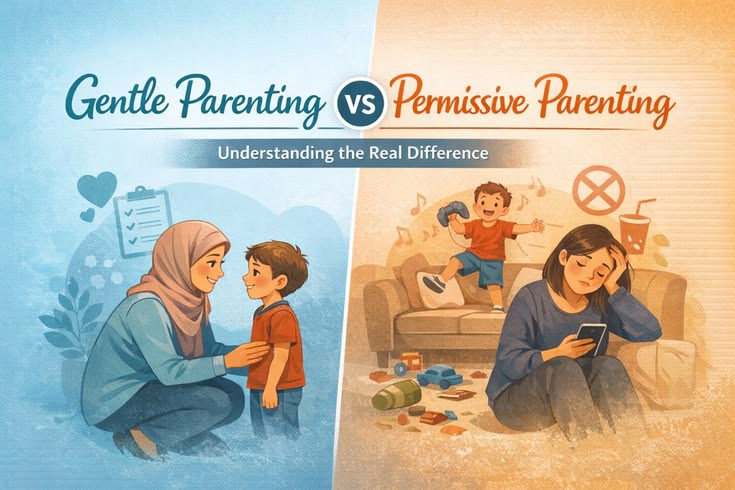
Every parent wants the same thing deep down. They want their child to grow up fulfilled, kind, and confident. But the way we arrive there looks very different from family to family. Some parents set firm rules. Some let their kids lead the way. And many are stuck somewhere in the middle, trying to figure out the right path without hurting their child or losing their mind.
If you have ever Googled “gentle parenting vs. permissive parenting,” you are not alone. Millions of parents ask this exact question every day because both styles look similar on the outside but feel unique at home. This guide breaks it all down in plain, simple words so you can understand what each style really means, how they affect your child, and what actually works.
What Are Parenting Styles and Why Do They Matter?

Before we compare anything, it helps to know what parenting styles are. Researchers have studied how parents raise kids for decades. They found four main parenting styles that most parents fall into. These are authoritative parenting, authoritarian parenting, permissive parenting, and gentle parenting.
Each style affects how a child learns to handle emotions, follow rules, build friendships, and deal with challenging moments. The parenting style you use is not just about today. It shapes your child for years to come.
What Is Gentle Parenting?
Gentle parenting is a way of raising kids with empathy, respect, and firm but kind boundaries. It does not mean saying yes to everything or avoiding tough talks. It means you guide your child with calm words and clear expectations instead of fear, yelling, or punishment.
A gentle parent listens to their child’s feelings and takes them seriously. However, they still maintain their boundaries when necessary. Gentle parenting uses something called positive discipline. This means teaching kids what to do instead of just punishing them for what they did wrong.
Core Traits of Gentle Parenting
Empathy first. You try to understand why your child is upset before reacting. If your toddler throws a toy, you ask yourself what need they are trying to meet, not just how to stop the behavior.
Clear, loving boundaries. Gentle parents say no. They just say it with kindness. “I understand you desire additional screen time, but it is now time to go to bed.” Giving in because you feel bad is not a good idea.
Emotional coaching. You help your child name their feelings and find healthy ways to express them. This builds emotional intelligence over time.
Natural consequences. Instead of threatening punishment, you let logical results teach the lesson. If they skip homework, they face the teacher. You do not shield them from that.
Consistent follow-through. Gentle parenting only works when you mean what you say. Kids need to trust that your words match your actions.
Research from the National Institutes of Health shows that warm, responsive parenting with consistent structure leads to better emotional regulation and stronger social skills in children. That is exactly what gentle parenting aims for.
What Is Permissive Parenting?
Permissive parenting comes from a place of love, just like gentle parenting. But the big difference is boundaries. Permissive parents avoid rules and conflict. They want their kids to be joyful in the moment, even if it causes problems later.
A permissive parent often gives in when a child cries, argues, or pushes back. Rules exist but are rarely enforced. The word “no” gets taken back easily. Over time, kids learn that pushing aggressively enough gets them what they want.
Core Traits of Permissive Parenting
Very few enforced rules. Kids go to bed when they want. They eat what they want. They skip chores without real consequences.
Avoiding conflict. The parent gives in to avoid a meltdown, even when they know the behavior is wrong.
High warmth, low structure. Permissive parents love their kids deeply. But love without structure leaves kids without a map for how the world works.
Treating kids like friends. Permissive parents sometimes act more like a buddy than a guide. This approach feels beneficial, but takes away the security children need from a parent figure.
Low expectations for behavior. When kids face few consequences, they struggle to understand what is acceptable in the real world.
Studies indicate that permissive parenting effects include higher rates of school misconduct, lower self-discipline, and difficulty respecting authority figures like teachers. Children raised in this manner often experience underlying anxiety, as they perceive themselves as the ones in control, a daunting responsibility for a child.
Gentle Parenting vs Permissive Parenting: The Real Difference
Here is the simplest way to say it. Both styles want joyful kids. But one teaches the child how to handle life, while the other tries to protect the child from it.
Gentle parenting asserts, “I love you, and I will not allow you to hit your brother.” Permissive parenting asserts, “I love you, so I will overlook it when you hit your sibling.”
That one sentence holds the whole difference. Gentle parenting keeps the warmth and adds a boundary. Permissive parenting keeps the warmth and removes the boundary.
Gentle Parenting vs Permissive Parenting Examples
Real-life examples make the distinction much clearer. Let us look at a few everyday situations parents face.
The Homework Battle
It is 8 PM. Your child is watching TV and has not touched their homework.
Gentle parenting response: “Homework needs to be done before any screen time. I am here if you need help. Let us get it started now.”
Permissive parenting response: “I do not want to fight about it. Just do it when you are ready.”
The gentle parent holds the rule. The permissive parent expects the child to self-regulate, but most kids aren’t ready.
The Bedtime Struggle
Your child keeps asking for five more minutes, and you have already said yes three times.
Gentle parenting response: “I understand you want to stay up. But bedtime is 8:30, and that is not changing tonight. Let us pick a book to read together.”
Permissive parenting response: “Okay, just a little longer,” until it is 11 PM and everyone is exhausted and frustrated.
The Tantrum in the Store
Your child wants a toy and starts crying loudly in public.
Gentle parenting response: “I can see you really want that toy. It is hard not to get what we want. We are not buying it today.” Then, you maintain your composure, even in the face of tears.
Permissive parenting response: Buying the toy to stop the meltdown, which teaches the child that crying is a winning strategy.
Is Gentle Parenting Permissive Parenting?
This is one of the most common questions parents search for online, and it comes up a lot on parenting forums and Reddit threads. The short answer is no. Gentle parenting is not permissive parenting.
They get confused because both avoid harsh punishments like spanking or yelling. But the key difference is boundaries. Gentle parenting has clear, consistent boundaries. Permissive parenting does not enforce them.
Think of it this way. A gentle parent is a kind coach. A permissive parent is a cheerleader who never calls a foul. The coach wants the child to grow. The cheerleader just wants them to feel good right now.
Gentle Parenting vs Authoritative Parenting
Authoritative parenting is actually the most well-studied parenting style in child psychology. Research consistently shows it leads to the best outcomes for kids. Here is the thing: gentle parenting and authoritative parenting are very similar.
Both use warmth, clear expectations, emotional support, and consistent boundaries. The main difference is that gentle parenting puts extra weight on emotional connection and the child’s inner experience. Authoritative parenting focuses slightly more on the child meeting behavioral expectations with warmth on the side.
Many experts consider gentle parenting a modern, emotion-focused version of authoritative parenting. If you are doing gentle parenting right, you are very close to authoritative parenting.
Gentle Parenting vs Strict Parenting
Strict parenting, often called authoritarian parenting, is the opposite of both gentle and permissive parenting. Strict parents have many rules and high expectations, but they enforce them through fear, punishment, and control instead of connection and understanding.
Children raised in strict homes often follow rules out of fear. They may struggle with self-esteem, have difficulty making decisions on their own, or rebel fiercely during the teen years. Research links strict, cold parenting to higher anxiety and lower emotional regulation in children.
Gentle parenting finds the middle ground. Rules exist. Consequences exist. But they are delivered with respect and empathy, not threats.
Gentle Parenting vs Permissive Parenting vs Authoritative Parenting: Quick Side-by-Side
Gentle parenting: high warmth, clear boundaries, emotion-focused, and teaching self-regulation.
Permissive Parenting: High warmth, weak boundaries, conflict-avoidant, low expectations.
Authoritative Parenting: High warmth, firm boundaries, balanced, and research-backed best outcomes.
Authoritarian (Strict) Parenting: Low warmth, rigid rules, obedience-driven, punishment-based.
How Permissive Parenting Effects Show Up Over Time
Permissive parenting effects do not always appear right away. A young child raised permissively might seem happy and easygoing. The problems often show up later.
By middle school, kids who grew up without real boundaries often struggle to follow classroom rules, work through frustration, or accept that they cannot always get their way. Teachers notice this quickly. These children are not bad kids. They simply were not given the chance to practice handling hard things at home.
In social settings, kids from permissive homes may push peers around, have trouble with give-and-take in friendships, or fall apart when things do not go their way. These are skills that need to be taught, and gentle parenting teaches them intentionally.
Why Parents Fall Into Permissive Parenting
It is worth saying clearly: permissive parents are not bad parents. Most of the time, they are trying very hard. Many parents become permissive because they do not want to repeat what their own parents did. They were raised with too much yelling or too many harsh punishments, and they do not want that for their kids.
The result is they swing too far the other way. They are afraid that any rule or consequence will damage the relationship. But children actually feel safer when there are predictable limits. A child who can trust their parent to keep promises and hold the line feels more secure, not less loved.
Read more about Parenting.
Conclusion
Understanding gentle parenting vs permissive parenting is one of the most useful things a parent can do today. Both styles care deeply about children. But only one gives kids the tools they actually need for real life.
Gentle parenting is not about being perfect or never losing your cool. It is about showing up with empathy and a clear, consistent message: “I love you, and I will guide you.” Permissive vs gentle parenting really comes down to whether you are willing to hold the line even when your child pushes back. That line is not a wall between you and your child. It is the foundation they stand on as they grow.
Frequently Asked Questions
What is the main difference between gentle parenting and permissive parenting?
Gentle parenting has kind but firm boundaries. Permissive parenting avoids enforcing rules to prevent conflict.
Is gentle parenting the same as permissive parenting?
No. Gentle parenting includes clear limits. Permissive parenting lacks consistent boundaries.
What are the effects of permissive parenting on kids?
Kids may struggle with self-discipline, following rules, handling frustration, and respecting authority.
Can gentle parenting work with strong-willed children?
Yes. Gentle parenting works especially well with strong-willed kids when boundaries are clear and consistent.
Which parenting style is best for child development?
Authoritative parenting has the most research support. Gentle parenting is very similar and effective when applied with real boundaries.
1 thought on “Gentle Parenting vs Permissive Parenting Explained in Simple Words ”