


It was 3:12 in the morning. My husband and I were both standing in the kitchen him holding a screaming baby, me running on maybe four hours of broken sleep and somehow we ended up in a full-blown argument about who forgot to buy more diapers. It wasn’t really about the diapers. We both knew that. But in that moment? It was war.
If that scenario sounds even a little bit familiar, I want you to take a deep breath and know this: you are not failing as a couple. You are going through one of the most documented, research-confirmed relationship transitions in human psychology, and nobody warns you about how hard it actually is.
📊 Research Says: According to the Gottman Institute, 67% of couples experience a significant drop in relationship satisfaction within the first three years after having a baby. That’s not a relationship red flag, that’s a near-universal human experience.
Postpartum relationship conflict is real, it’s normal, and it almost always hits hardest in the first year. What makes the difference isn’t whether you fight, it’s how you understand and move through those fights. This guide breaks down the most common fights couples have after a baby, what’s really driving them, and crucially what you can say (and do) differently.
We’ll also cover something most articles skip completely: how these fights evolve month by month, what the research says about repair after conflict, and the actual red flags that mean it’s time to get help.
Why Having a Baby Makes Couples Fight More The Science

Before we get into the fight list, let’s talk about why this happens at all. Because understanding the root cause is honestly the fastest path to fighting less.
It’s not that you married the wrong person. It’s not that your relationship was secretly broken. It’s that sleep deprivation, hormonal shifts, identity disruption, and invisible labor all hit at the exact same time and your brain literally cannot handle that the way it usually would.
Sleep deprivation is probably the biggest culprit. When you’re running on fragmented sleep for weeks, your prefrontal cortex the part of your brain responsible for impulse control, empathy, and rational decision-making basically clocks out. Meanwhile, your amygdala (your emotional alarm system) becomes hypersensitive. A comment that would normally roll off your back can feel like a personal attack. This is called an amygdala hijack, and new parents are living in it.
Then there’s the labor visibility gap. Both partners are working incredibly hard but much of that work is invisible to the other person. The mental load of planning, anticipating, and managing everything tends to fall asymmetrically. And when your effort goes unacknowledged, postpartum resentment builds fast.
On top of that, both parents are also going through an identity transition simultaneously. Mothers experience matrescence a genuine psychological and neurological rebirth that’s as significant as adolescence. And fathers? They’re quietly navigating their own version of this, often feeling sidelined or unsure of their new role. Nobody is the same person they were before the baby arrived.
Understanding this doesn’t make the fights disappear. But it does make them feel less like personal attacks and more like what they actually are: two exhausted, transformed humans trying their best.
11 Common Fights Couples Have After Baby
FIGHT #1 “I’m More Exhausted Than You” The Competitive Suffering Trap

This one starts innocently enough. One partner sighs loudly. The other interprets it as a challenge. And before you know it, you’re both essentially auditing each other’s suffering comparing sleep logs, baby-holding minutes, and diaper changes like it’s a courtroom.
Here’s the thing: both of you are right. You’re both exhausted. The problem is that the fight isn’t really about who’s more tired it’s about not feeling seen or acknowledged. When you feel unseen, you compensate by making your suffering louder.
Instead of: “You have no idea how tired I am.” Try: “I’m really struggling today and I just need you to know that even if you’re struggling too.”
FIGHT #2 Nighttime Duty Division The 2am Resentment Cycle
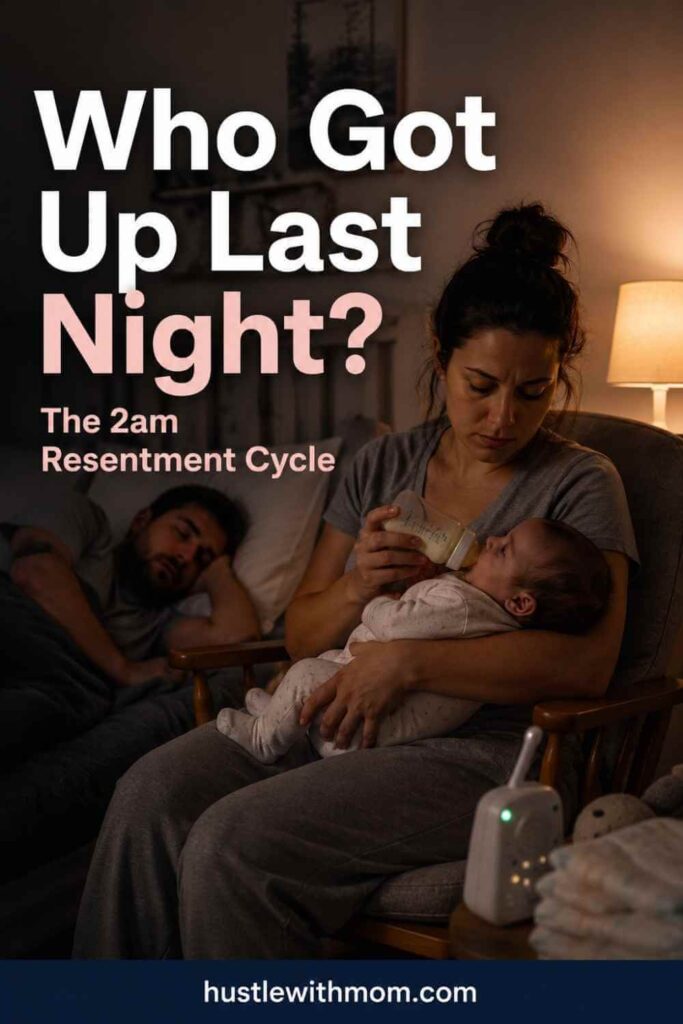
Who gets up with the baby at 2am is probably the single most common source of new parent relationship conflict. And it’s genuinely complicated by breastfeeding, work schedules, and the fact that both of you are operating on survival mode.
What makes this fight particularly destructive is the silent scoreboard. Both partners are mentally tracking who did what, who got more sleep, and who “owes” the next feeding. The scoreboard is never balanced. It can’t be.
The fix isn’t perfectly splitting shifts it’s agreeing on a sleep strategy before resentment builds. Something like “you take midnight to 3am, I take 3am to morning” beats “whoever wakes up deals with it” every single time.
Instead of: (No clear plan, just silent resentment) Try: “Can we sit down tomorrow and map out who takes which shifts this week? I think we’d both feel less resentful if we had a plan.”
FIGHT #3 The Mental Load Imbalance “Why Do I Have to Think of Everything?”
The mental load all the invisible planning, scheduling, anticipating, and managing that keeps a household and baby alive is one of the most under-discussed sources of postpartum relationship conflict.
It’s not about whether chores are split evenly. It’s about who’s carrying the cognitive weight of knowing what needs to happen, when, and how. This tends to fall disproportionately on mothers and creates a slow-burning resentment that’s hard to articulate until it explodes in an argument about something seemingly minor.
The solution isn’t “just ask me to help.” That adds more mental load to the person already overwhelmed by it. It’s about genuinely owning domains one person takes 100% responsibility for certain tasks, instead of one person managing everything and occasionally delegating.
FIGHT #4 Parenting Style Clashes “That’s Not How You’re Supposed to Do It”
You both read different things. Or nothing at all. One of you had a strict upbringing and wants structure; the other was raised more freely and resists it. Add in decisions about sleep training, screen time, gentle parenting, and feeding schedules, and suddenly you’re two people with completely different philosophies arguing over a tiny human who can’t talk yet.
The mistake here is framing it as one person being “right.” Most parenting disagreements don’t have a correct answer they just need an agreement. Talking about your non-negotiables versus your preferences can be a game-changer.
FIGHT #5 Sex and Intimacy The “Touched Out” Wall
This one is genuinely hard to talk about. One partner wants physical closeness; the other has been touched, held, and nursed on for 16 hours straight and desperately needs not to be touched.
The “touched out” phenomenon especially common in breastfeeding mothers is real and physiological. The hormone prolactin, which is elevated during breastfeeding, actually suppresses libido. Your body isn’t broken. It’s doing exactly what it’s designed to do.
Loss of physical intimacy after baby is one of the most common reasons couples feel disconnected in the postpartum period. The key is talking about it outside of a moment of pressure.
Instead of: “You never want to be intimate anymore.” Try: “I miss feeling close to you. I’m not pressuring anything can we just spend 20 minutes tonight actually talking or cuddling? No agenda.”
FIGHT #6 The In-Law Interference Battle
In-law conflict after baby is incredibly common, and it almost always becomes a couple fight because partners feel caught between their families and each other. Unsolicited advice, unannounced visits, conflicting cultural expectations it adds up fast.
The golden rule here: each partner handles their own family. You don’t criticize your partner’s mother but they absolutely should be the one setting limits with her.
FIGHT #7 Financial Stress The Budget Fight in Disguise
Maternity leave income gaps, the shocking cost of daycare, gear you didn’t budget for financial stress for new parents is enormous, and it often disguises itself as other arguments.
Couples who never fought about money before the baby may find themselves in heated arguments now not because they’re irresponsible, but because their financial reality has genuinely shifted. Having an honest, judgment-free monthly money conversation can prevent a lot of blowups.
FIGHT #8 “You Just Don’t Get It” The Stay-At-Home vs. Working Parent Divide
If one partner stays home with the baby while the other works outside the home, prepare for the “whose day was harder” fight to become a recurring theme.
The working parent comes home depleted, wanting to decompress. The at-home parent has been “on” all day with no real breaks and is desperately waiting for a moment of relief. Neither experience is wrong. Both feel invisible to the other.
What helps: instead of comparing, try narrating your day to each other not to compete, but to actually understand what the other experienced.
FIGHT #9 Social Media Parenting Comparison The Modern Fight Nobody Talks About
“Perfect parent” pressure from social media is actively fueling conflict between couples. You’re up at midnight, exhausted, and you scroll past a perfectly lit Instagram reel of a calm, glowing mom doing baby sensory play in a clean living room. Your partner says, “maybe we should try that.” You want to scream.
One partner feels criticized. The other feels like they’re just trying to do right by their baby. The algorithm doesn’t show you the disasters only the highlights.
If this is a recurring friction point, consider a mutual agreement to unfollow accounts that consistently make you feel inadequate. You’re not failing because your baby’s nursery doesn’t look like a Pinterest board.
FIGHT #10 “I Don’t Know Who I Am Anymore” The Identity Fight
Matrescence the psychological and neurological identity shift mothers go through after having a baby is as significant as adolescence. Your sense of self, your relationships, your body, your ambitions: all of it is being renegotiated at once. And when a partner doesn’t recognize or honor that shift, it creates enormous conflict.
This fight often comes out sideways. It doesn’t start as “I’m going through a profound identity transformation.” It starts as a fight about going back to work, or getting a night out, or not feeling like yourself.
For partners reading this: when she says “I don’t feel like myself,” she’s not complaining about you. She’s telling you she’s going through something enormous. The most powerful thing you can say is: “I see how much you’ve changed and I think you’re incredible.”
FIGHT #11 The Father Who Feels Sidelined The Invisible Struggle
We talk a lot about what mothers go through postpartum. We talk very little about fathers.
Many dads quietly transition from equal partner to feeling like a “helper” someone who assists the mother rather than an equal parent. And up to 10% of new fathers experience Paternal Postnatal Depression (PPND) which often looks not like sadness, but like irritability, anger, withdrawal, or increased risk-taking.
If your partner seems angry, checked out, or strangely absent even when he’s physically there this might be worth a compassionate conversation rather than a fight.
How Fights Evolve: A Month-by-Month Reality Check
Here’s something I wish someone had told me: the fights you’re having at six weeks postpartum are completely different from the ones at six months. Understanding the pattern helps you know you’re not stuck you’re in a phase.
0–3 Months: Survival Mode
Everything is about logistics: who’s feeding, who’s sleeping, who’s holding the baby. Fights are sharp, fast, and often about nothing. Sleep deprivation is at its worst. This is the phase where you’re most reactive and least able to communicate well. Cut yourselves a lot of grace here.
3–6 Months: The Pressure Cooker
You’ve survived the newborn fog, but now postpartum resentment has had time to settle. Patterns have formed who does what, who asks for help, who doesn’t. If those patterns feel unfair, this is when they start to calcify into real grievances.
6–12 Months: Identity and Intimacy
This is when many couples realize they’ve been running in parallel rather than together. The physical intimacy gap has widened. Identity questions peak. The question “do I even like who we’ve become?” sometimes surfaces and it’s worth taking seriously rather than dismissing.
12–24 Months: The Coparenting Drift
By the time your baby is a toddler, many couples have quietly shifted from romantic partners to efficient co-managers of a household. You’re coordinating schedules, splitting kid logistics but you’ve stopped being a couple. This is the “coparenting drift,” and it’s one of the most underrecognized relationship risks of early parenthood.
Exact Scripts: What to Say Instead
Every article tells you to “communicate better.” But what does that actually sound like at 9pm when you’re both running on empty? Here’s a practical reference you can actually use.
| ❌ Instead of saying this… | ✅ Try this instead |
| “You never help with the baby.” | “I’m feeling overwhelmed. Can we figure out how you can take on more of [X]?” |
| “I’m more tired than you.” | “We’re both exhausted. Can we plan recovery blocks for each of us this week?” |
| “Your mother keeps interfering.” | “Can we talk about grandparent boundaries that feel right for both of us?” |
| “You just don’t get what it’s like for me.” | “I don’t think you fully understand my days can I walk you through it? I want to understand yours too.” |
| “You never want to be intimate anymore.” | “I miss feeling close to you. No pressure can we just have 20 minutes of connection tonight?” |
| “I need a break!” (mid-fight) | “I’m getting overwhelmed. Can we pause for 30 minutes and come back calmer?” |
Notice the pattern: you’re not removing emotion from the conversation. You’re redirecting it toward a specific need or request, rather than an accusation. That small shift is the whole game.
After the Fight: What the Research Says About Repair
Even if you use every script perfectly, you will still fight. And when you do, what happens after the fight matters more than most couples realize.
The Gottman Institute’s research on what they call repair attempts is genuinely useful. A repair attempt is any action one partner takes to de-escalate tension during or after a conflict. It could be as simple as touching someone’s arm, making a self-deprecating joke, or saying “I’m sorry I said that harshly.”
💡 Gottman Tip: Successful couples make repair attempts early and often and their partner actually receives them. A genuine “I’m sorry, I was out of line” goes further than a perfectly reasoned apology delivered 48 hours later.
Another key finding: couples need a 5:1 ratio of positive to negative interactions to maintain relationship health. New parents are generating negative interactions at a higher rate than usual, which means you need to intentionally create more micro-moments of positivity to compensate.
This doesn’t have to be grand gestures. A 6-second hug. Saying “thank you for doing that.” A laugh about something absurd the baby did. These bids for connection are the scaffolding on which your relationship is built.
Also, please don’t try to resolve a big fight while you’re both in the thick of it. The 24-hour rule, letting yourselves cool down fully before revisiting a charged topic, dramatically improves the quality of those conversations.
Red Flags: When Normal Fighting Signals Something Serious
Most postpartum fighting is normal. But some patterns are signs that you need more support than a good conversation can provide. Knowing the difference matters.
The Gottman Institute identifies four behaviors nicknamed the “Four Horsemen” that predict relationship breakdown if they become habitual: contempt, criticism, defensiveness, and stonewalling. Of these, contempt (eye-rolling, mockery, treating your partner with disdain) is the single strongest predictor of divorce.
- Stonewalling: One partner consistently withdrawing and shutting down emotionally during all conflicts
- Contempt: Eye-rolls, mockery, dismissiveness becoming the default tone on a regular basis
- Postpartum rage in the mother: Explosive anger that feels disproportionate and frightening (a clinical symptom, not a character flaw and it’s treatable)
- Paternal Postnatal Depression (PPND): A father who is significantly angrier, more impulsive, or more withdrawn than before the baby
- Fighting in front of children regularly in a way that feels unsafe or out of control
- Thoughts of leaving that are no longer fleeting but feel like a real plan
- Either partner feeling consistently unsafe, belittled, or controlled
If any of these feel familiar, please talk to someone a therapist, a doctor, or a trusted support person. Couples therapy isn’t a last resort; it’s one of the most proactive investments you can make for your family.
Frequently Asked Questions
Is it normal to fight a lot after having a baby?
Yes completely. Research shows that most couples experience increased conflict and decreased relationship satisfaction in the first one to three years after having a baby. Sleep deprivation, labor division, and identity shifts all converge at once. It’s one of the most well-documented relationship transitions in psychology.
How long does relationship conflict last after a baby?
The most intense period of postpartum relationship conflict tends to peak in the first 6–12 months. However, the Gottman Institute’s research notes that relationship satisfaction can be affected for up to three years postpartum. Couples who actively work on their communication and connection recover much faster than those who just wait it out.
What do couples fight about most after having a baby?
The most common fights center on sleep and nighttime duty, the division of household and baby labor, sex and intimacy loss, parenting style differences, in-law interference, and financial stress. Underneath most of these fights is a shared need to feel seen, valued, and not alone.
Is it normal to resent your partner after having a baby?
Yes, and it’s extremely common especially when the mental load or physical workload feels unequal. Resentment is a signal, not a verdict on your relationship. It usually means a need isn’t being met or acknowledged. Naming it early and calmly is much more effective than letting it build until it explodes.
Will my relationship get better after the newborn phase?
For most couples, yes especially if you’re actively communicating and connecting rather than just co-parenting in parallel. The newborn and infant stages are genuinely one of the hardest periods for a relationship. Couples who come through it often describe their partnership as deeper and more resilient than before.
Conclusion:
Here’s what I want you to take away from all of this: the fact that you’re fighting isn’t the problem. It’s actually proof that you’re both still showing up, still caring, still invested in something that matters to you.
The couples who quietly drift apart after a baby don’t always fight. Sometimes they just… stop talking. Stop reaching for each other. Become roommates who share childcare duties. That’s the version I’d actually worry about more.
If you’re in the thick of it right now, try picking just one thing from this article. Just one. Whether it’s the 24-hour rule, one of the scripts, or simply acknowledging your partner’s exhaustion without turning it into a competition.
You don’t need to overhaul your entire relationship. You just need to keep making small bids for connection, keep choosing each other on the hard days, and keep remembering that you’re on the same team even when it doesn’t feel that way at 3am.
Read next: 15 Honest Tips for Exhausted New Moms That Actually Help · Postpartum Planner for Mom · 15 Ways to Be a Calm Mom Every Single Day
hustlewithmom.com · Relationship & Postpartum