

I remember sitting on my bathroom floor at 11 weeks pregnant, crying into a towel because I felt absolutely nothing like the glowing mom-to-be everyone kept talking about. I was nauseous, exhausted, irritable, and honestly a little resentful of my own body. And then the guilt hit even harder than the nausea. If not enjoying pregnancy made me a bad mom already, what kind of parent was I going to be?
If you’re here because you typed some version of “why am I not enjoying pregnancy” into Google at 1am, I want you to exhale for a second. You are not broken, you are not ungrateful, and you are absolutely not alone. A huge number of pregnant women feel the exact same way and just never say it out loud.
This isn’t going to be one of those generic lists that tells you to “stay positive” and calls it a day. I’ve been through it, I’ve talked to other moms who’ve been through it, and I’ve dug into what actually helps versus what just sounds nice on paper. Let’s get into it.
Is It Normal to Not Enjoy Being Pregnant?
Yes. Genuinely, yes.
The “pregnancy glow” idea is mostly a highlight reel, the same way Instagram is a highlight reel. Some women do love every second of it. A lot of women love their baby and still can’t stand the process of growing them. Both things can be true at once.
Research on pregnancy ambivalence backs this up too. Mixed feelings during pregnancy, from mild frustration to genuine dread, are common enough that perinatal psychologists have a whole body of research on it. You’re not an outlier. You’re just someone who isn’t performing for social media.
7 Common Reasons You’re Not Enjoying Pregnancy
Understanding why you feel this way can take a lot of the sting out of it. Here’s what tends to be behind that heavy, “I can’t do this” feeling.
1. Physical Symptoms Are Wearing You Down
Nobody warns you how relentless pregnancy symptoms can be. Nausea that lasts all day (not just mornings, despite the name), crushing fatigue, heartburn, and swelling can make even simple days feel impossible.
If you’re dealing with early pregnancy bloating, aching joints, or that deep second-trimester exhaustion, it’s genuinely hard to feel joyful when your body feels like it’s working against you. I’ve written more specifically about second trimester fatigue and how to manage it without burning out completely, plus practical fixes for bloating in early pregnancy if that’s part of your struggle too.
2. Hormonal Shifts Are Affecting Your Mood
Your hormone levels, particularly estrogen and progesterone, shift dramatically during pregnancy. This isn’t just physical; it directly impacts your mood regulation, patience, and emotional resilience.
It’s not “just hormones” in a dismissive way. It’s a real, measurable biological shift, and it’s a completely legitimate reason you might feel more irritable, weepy, or flat than usual.
3. You’re Grieving Your Old Body and Lifestyle
This one doesn’t get talked about enough. Pregnancy asks you to give up wine with friends, your favorite workout routine, certain foods, and even your regular sleep position. That’s a real loss, even when the outcome is something wonderful.
Feeling a sense of body image struggles or missing your old routine doesn’t mean you don’t want your baby. It means you’re human, and change, even good change, comes with grief.
4. Comparison Culture and the “Glowing Mom” Myth
Scrolling through curated pregnancy photos while you’re hunched over a toilet bowl is a recipe for feeling like a failure. But what you’re seeing online is a snapshot, not the whole story. Most of those glowing photos left out the 3am heartburn and the ankle swelling.
If comparison is dragging you down, try muting or unfollowing accounts that make you feel worse instead of supported. Your feed should help you, not add pressure.
5. Anxiety About the Baby’s Health or a High-Risk Pregnancy
If you’re managing a high-risk pregnancy, recurring appointments, or worry after a previous loss, it’s incredibly hard to relax into the experience. Constant vigilance is exhausting, and it eats into the joy that “should” be there.
This kind of pregnancy anxiety is common and valid. It doesn’t mean you’re overreacting; it means your nervous system is doing its job under real stress.
6. Relationship or Financial Stress
Pregnancy doesn’t happen in a vacuum. If you and your partner are fighting more, or you’re stressed about money, childcare, or work leave, that stress bleeds directly into how you experience the pregnancy itself.
I’ve written about common fights couples have after having a baby, and honestly, a lot of that friction starts during pregnancy, not after. Addressing it early can make a real difference.
7. Unplanned Pregnancy or Complicated Timing
If this pregnancy wasn’t planned, or came at a genuinely hard time in your life, it’s normal to have complicated, tangled feelings. You can be scared, ambivalent, and still love the baby growing inside you. None of that is a contradiction.
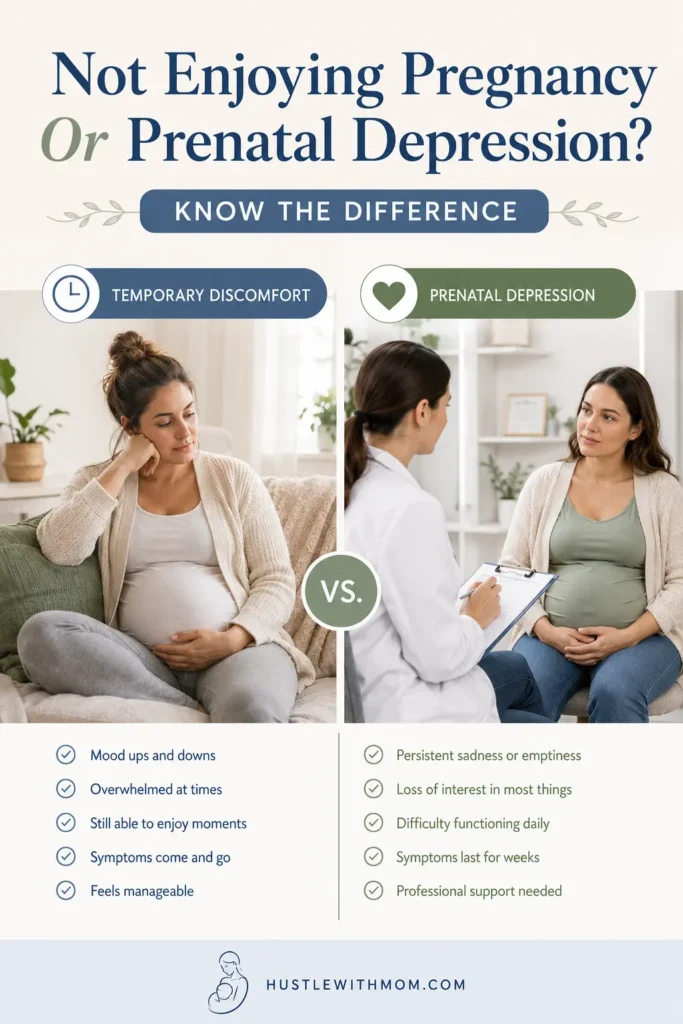
Not Enjoying Pregnancy vs. Prenatal Depression: How to Tell the Difference
This is the part most articles skip, and it’s honestly the most important section here.
Not enjoying pregnancy in the “this is physically and emotionally hard” sense is different from prenatal (antenatal) depression. Both are real, but they need different responses.
It’s likely just normal pregnancy struggle if:
- You have bad days, but also okay or good days
- You still feel connected to your life, hobbies, and relationships (even if tired)
- Your frustration is tied to specific symptoms or circumstances
- You can talk yourself through low moments, even if it takes effort
It may be prenatal depression or anxiety if you notice:
- A persistent low mood that lasts most of the day, nearly every day, for two weeks or more
- Loss of interest in things you used to enjoy
- Feelings of hopelessness or worthlessness
- Intrusive, frightening thoughts
- Trouble sleeping even when you’re exhausted, or sleeping far too much
- Difficulty functioning at work or in relationships
According to the American College of Obstetricians and Gynecologists (ACOG), perinatal mood and anxiety disorders are common and treatable, and providers now recommend routine screening during pregnancy visits, not just after birth. If any of the second list sounds familiar, please bring it up with your OB or midwife. You can also find confidential support through Postpartum Support International, which despite the name also supports people struggling during pregnancy, not just after.
Reaching out isn’t weakness. It’s the same kind of proactive care as taking your prenatal vitamins.
How to Cope When You’re Not Enjoying Pregnancy
Here’s what actually helped me, and what other moms consistently mention, beyond the generic “think positive” advice.
Be Honest Instead of Performing Happiness
Stop pretending you’re thrilled when you’re not. When someone asks how you’re feeling, you’re allowed to say “honestly, it’s been rough.” You’ll be shocked how many people quietly say “same” the second you give them permission.
Separate “Not Enjoying Pregnancy” From “Not Wanting the Baby”
These are two completely different things, and your brain needs to hear that distinction clearly. You can dislike the process and still be deeply excited to meet your baby. Write it down if you need to see it in your own handwriting.
Build a Support System That Gets It
Find your people, whether that’s one honest friend, an online community, or a local pregnancy support group. Having somewhere to vent without judgment takes a huge weight off.
Try Small, Low-Pressure Bonding Moments
If bonding with the bump feels hard, don’t force big rituals. A five-minute walk while talking quietly to your belly, or picking out one small item for the nursery, counts. Small and consistent beats big and forced.
Protect Your Sleep, Food, and Movement
Your gut and brain are more connected than people realize, and blood sugar crashes make everything feel worse emotionally. Simple pregnancy meal prep can genuinely take the edge off exhausting days when cooking feels impossible; I break down easy options in my pregnancy meal prep guide.
Gentle movement helps too, even if it’s just a short walk. If joint or SI joint pain during pregnancy is holding you back, modify rather than skip it entirely, and check in with your provider about safe options.
Reframe the Timeline, Trimester by Trimester
Instead of dreading “the next nine months,” break it down. Get through this week. Get through this appointment. My guide on first trimester tips and general things to do while pregnant can help you find small wins to look forward to along the way.
Set Boundaries With Unsolicited Comments
You don’t owe anyone a smile or an explanation for how you’re feeling. “I appreciate that, but I’m just taking it one day at a time” is a complete sentence.
Give Yourself Permission to Grieve and Complain
You’re allowed to mourn wine nights, your old sleep schedule, and your pre-pregnancy energy. Complaining isn’t ungrateful. It’s how humans process hard things.
What to Say to Yourself Instead

| Instead of thinking this | Try this |
| “Something is wrong with me” | “My body and hormones are going through a massive shift” |
| “I should be grateful, so I can’t complain” | “I can be grateful for my baby and still find this hard” |
| “I’m not bonding, so I’ll be a bad mom” | “Bonding often deepens after birth, not before” |
| “Everyone else loves this” | “Most people just don’t post the hard parts” |
Special Circumstances That Make Pregnancy Harder to Enjoy
Some situations naturally make not enjoying pregnancy even more intense:
High-risk pregnancies bring extra monitoring, worry, and physical limitations that add real emotional weight.
Pregnancy after loss or infertility often comes tangled with guilt for struggling, because “I wanted this so badly.” That guilt is common, and it doesn’t cancel out your right to find parts of it hard.
Hyperemesis gravidarum, severe and prolonged nausea and vomiting, is a genuine medical condition, not just “bad morning sickness.” If you’re dealing with this, please talk to your provider about treatment options rather than white-knuckling through it.
Unsupported or solo pregnancies remove a layer of built-in support that makes hard days feel more manageable. Leaning on community, whether friends, family, or local resources, matters even more here.
When to Seek Professional Help
If your low mood is constant, if you’ve lost interest in things you normally enjoy, or if you’re having thoughts of harming yourself, please reach out to your OB, midwife, or a mental health professional right away. You can also contact Postpartum Support International at their helpline for confidential support, day or night.
Getting help early doesn’t just protect you. Research consistently shows that treating prenatal depression and anxiety also supports better outcomes for the baby. Asking for help is one of the most protective things you can do for both of you.
FAQ’s
Is it normal to not be excited about being pregnant?
Yes. Excitement often comes and goes throughout pregnancy, and plenty of women feel more relief than excitement, especially in the early weeks.
Can you regret parts of pregnancy and still love your baby?
Absolutely. Disliking symptoms, exhaustion, or the physical toll doesn’t reflect how much you love the baby you’re carrying.
Does not enjoying pregnancy affect the baby?
Occasional stress and low mood are normal and not harmful. Persistent, untreated depression or anxiety is worth addressing with a provider, mainly for your own wellbeing and quality of life.
Will I bond with my baby if I’m not enjoying pregnancy?
In most cases, yes. Bonding is often gradual and tends to deepen significantly after birth, regardless of how pregnancy itself felt.
Final Thoughts
If you take one thing from this article, let it be this: not enjoying pregnancy doesn’t say anything bad about you or the mother you’re going to be. It just means you’re going through something genuinely hard, in a body that’s working overtime, while everyone around you talks about glow and magic.
Be honest about the hard days. Ask for help when you need it. And know that plenty of us have sat on that same bathroom floor, feeling exactly what you’re feeling right now, and came out the other side just fine, glow or no glow.