


I still remember the morning I stood in the kitchen at 5:03 AM, coffee untouched, staring at my baby monitor like it had personally betrayed me. My daughter had gone to bed at 7:30, slept beautifully until you guessed it at 5 AM on the dot. Every. Single. Morning.
I did what every sleep-deprived mom does: Googled it in a panic at 2 AM the night before it happened again. What I found was a rabbit hole of conflicting advice, and honestly, it took me weeks of trial and error to figure out what was actually going on.
If your baby is waking at 5 AM and refusing to go back to sleep, you are not alone and more importantly, you are not doing anything wrong. This is one of the most common sleep complaints parents have, and there are real, specific reasons it happens.
Let’s break it all down.
The Real Reason 5 AM Is Such a Problem Time
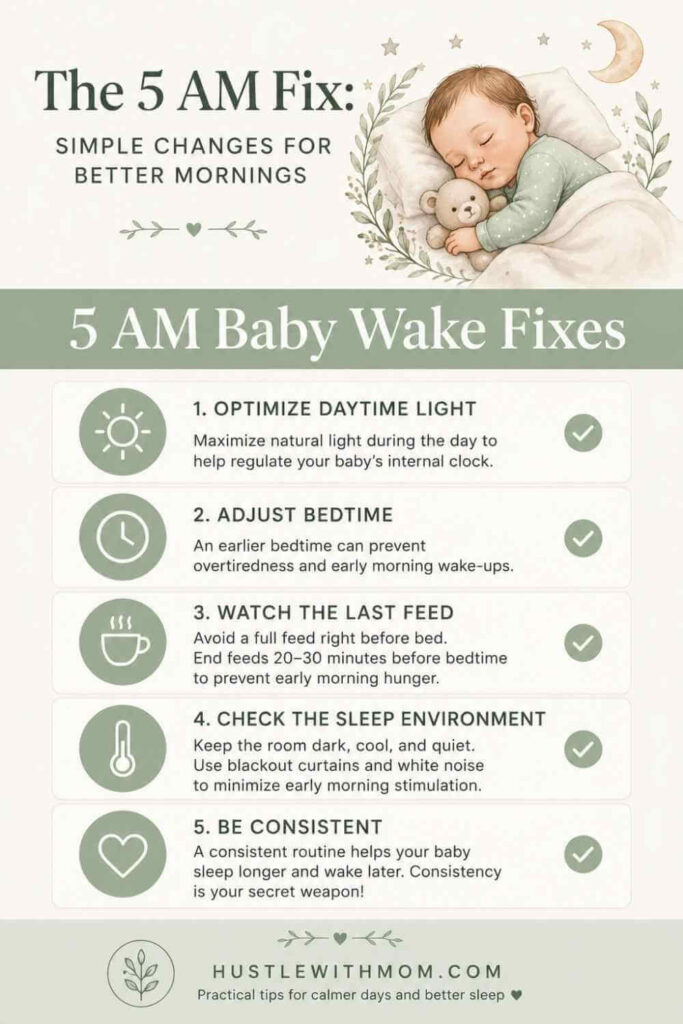
Here’s the thing most baby sleep articles don’t tell you clearly enough: 5 AM is a biologically vulnerable time for babies.
Between roughly 4–6 AM, babies cycle into their lightest sleep stages. Their cortisol (the wake-up hormone) starts rising naturally to prepare the body for the day. So any small disturbance, a noise, a light, a slightly wet diaper, hunger, or just coming to the end of a sleep cycle can fully wake them up instead of letting them drift back to sleep.
Adult sleep works the same way, by the way. You’ve probably had mornings where you woke up at 5 AM and just… couldn’t get back to sleep. For babies, it’s even more common because their sleep cycles are shorter (around 45–50 minutes) and their ability to self-settle is still developing.
Understanding this biological piece made everything click for me. It’s not random. It’s not your baby being difficult. There’s a reason this specific time is the culprit.
7 Common Reasons Your Baby Wakes at 5 AM
1. Their Bedtime Is Too Late (This One Surprised Me)
When my daughter started waking early, my first instinct was to push her to bed later. Surely if she went to bed at 9 PM, she’d sleep until 6 AM, right?
Wrong. Completely wrong and this is the mistake most parents make.
Overtired babies actually wake earlier because their bodies produce more cortisol to compensate for the exhaustion. The result? An even earlier wake time and a cranky baby to boot.
For most babies under 18 months, a bedtime between 6:30–7:30 PM is ideal. I know it sounds crazy, but an earlier bedtime often leads to later morning wake times. We moved my daughter’s bedtime 30 minutes earlier and within four days, the 5 AM wake started stretching to 6:15 AM. That extra hour and fifteen minutes felt like a miracle.
2. The Room Is Getting Light Too Early
This is the one nobody talks about enough. Light is your baby’s #1 biological wake signal. Even a small sliver of dawn light creeping under a curtain at 5:15 AM is enough to trigger their internal clock and tell their brain, “Morning! Time to wake up!”
Blackout curtains are non-negotiable for early risers. I’m not talking about the thin “room darkening” panels from a discount store. I mean the kind where you walk in at noon and can’t see your hand in front of your face.
We used Redi Shade Original Blackout Pleated Shades cheap, effective, and they stick directly to the window frame with no installation. After that, I also used black electrical tape around the edges where light was leaking in. It sounds intense, but it worked.
The room should be as dark at 5 AM as it is at midnight.
3. Hunger Especially Around Growth Spurts
If your baby is going through a growth spurt (common around 3–4 months, 6 months, 9 months, and 12 months), they may genuinely need more calories and wake early from hunger.
A few signs this is the cause: your baby wakes up crying urgently, feeds eagerly, and then either goes back to sleep or seems genuinely satisfied and bright-eyed afterward.
For breastfed babies especially, a “dream feed” around 10–11 PM can help bridge the gap. This is where you feed your baby while they’re still mostly asleep, topping off their tank before you go to bed. Many parents find this pushes the wake time later by an hour or more. Check out this guide on how to be a better mom for more on building sustainable feeding and sleep routines.
4. Their Total Sleep Window Is Too Long
Babies have a limited “sleep tank” ; they can only sleep so many hours in a 24-hour period. If your baby’s bedtime is 6:30 PM and they’re a 10-hour sleeper, well… the math says 4:30 AM wake time.
Before panicking about early rising, count up the total hours your baby is sleeping in a full day (including naps). If they’re hitting their developmental sleep target, then 5 AM might actually be their natural morning time, and the goal becomes nudging that window later over time rather than fighting biology.
Approximate total sleep needs by age:
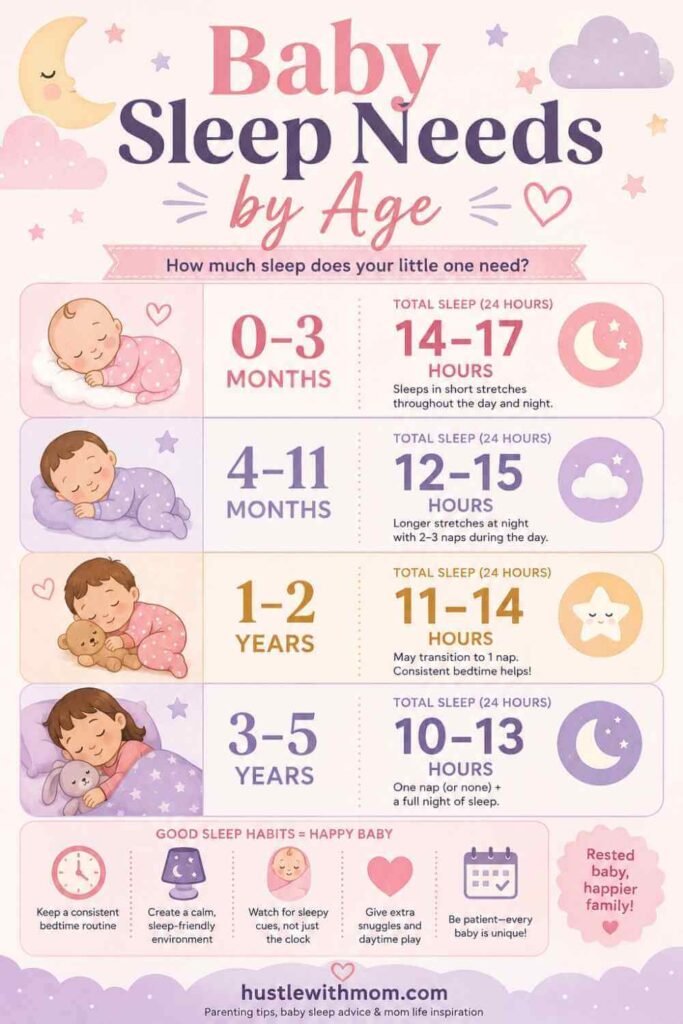
- 0–3 months: 14–17 hours
- 4–11 months: 12–15 hours
- 1–2 years: 11–14 hours
- 3–5 years: 10–13 hours
5. Noise Disturbances (Including the Ones You Can’t Hear)
The garbage truck. Birds chirping. Your partner’s alarm. Traffic picking up. Your upstairs neighbor’s early morning routine.
Babies at 5 AM are in light sleep, which means sounds that wouldn’t bother them at midnight can fully wake them in the early morning hours.
A white noise machine running continuously through the night is one of the most effective tools for early risers. We used the Marpac Dohm Classic (the one with the actual fan inside, not a digital simulation) and it genuinely smoothed over a lot of those early morning disturbances. Keep the volume consistent too quiet and it won’t mask noise, too loud can be startling in its own right.
Don’t turn it off when you go to bed. Let it run all night.
6. Nap Schedule Misalignment
This one took me forever to figure out. If your baby’s last nap of the day ends too early, say, a nap ending at 2:30 PM for a baby who goes to bed at 7:30 PM, that’s a five-hour wake window before sleep. For many babies, that’s simply too long, and they’ll arrive at bedtime overtired, sleep restlessly, and wake early.
Alternatively, if that last nap is ending too late (like 5 PM), it can push into the night sleep and compress it.
Getting nap timing right is honestly one of the trickiest parts of the baby sleep puzzle. A good starting point is to work backward from bedtime. Most babies do well with a 2–3 hour wake window before bed. So if bedtime is 7:00 PM, the last nap should ideally end by 4:30–5:00 PM at the latest.
7. A Sleep Association They Can’t Replicate Alone
If your baby falls asleep nursing, rocking, or with a pacifier and wakes at 5 AM in light sleep they’re going to look around, realize their “falling asleep tool” is gone, and need you to recreate it.
This isn’t a character flaw in your baby. It’s just that they haven’t learned to fall back asleep independently yet, and 5 AM is the time it’s hardest for them to do it on their own.
This is a bigger piece to address and often involves some gentle sleep training, which is a personal decision for every family. But recognizing this pattern is the first step.
What to Actually Do When Your Baby Wakes at 5 AM
Don’t Rush In Immediately
Give it 5–10 minutes if your baby’s cries aren’t urgent distress cries. Sometimes babies groan, fuss, and moan at this stage of sleep and then drift back off. If you rush in the moment you hear a peep, you confirm to their brain that 5 AM is the official start of the day.
Don’t Turn on the Lights or Start Your Morning Routine
This is huge. If you bring your baby out into a bright kitchen, start making breakfast, and interact with them animatedly at 5 AM, you’ve essentially told their circadian rhythm that 5 AM = morning. Keep everything dim, calm, and quiet. Treat it as “still nighttime.”
Try a Resettle Without Full Feeding (For Older Babies)
If your baby is over 6 months and you know they’re not hungry, try a gentle resettle, a hand on the back, a few shushes, and replace the pacifier without picking them up or feeding. It won’t always work, but sometimes it’s enough to bridge them to 6 or 6:30 AM.
Work on the Root Cause, Not Just the Symptom
All the in-the-moment tips only go so far. If the room is light, no amount of resettling will fix it. If the bedtime is wrong, you’ll be fighting the same battle every morning. Spend a week addressing the most likely cause for your baby specifically, then reassess.
How Long Does It Take to Fix Early Rising?
Honestly? It depends on what’s causing it and how consistently you address it. Blackout curtains can work within 1–3 days. Shifting bedtime usually shows results in 4–7 days. Sleep association work takes longer, often 2–3 weeks.
The biggest mistake parents make (I made this one) is trying one thing for two days, giving up, trying something else, and then giving up again. Pick your most likely culprit, commit to it for a full week, and watch what happens.
When 5 AM Is Just Your Baby’s Natural Wake Time
Here’s the hard truth some sleep consultants will tell you: some babies are genuinely early risers. If you’ve addressed every possible cause darkness, bedtime, naps, sleep associations, hunger and your baby is still waking between 5 and 5:30 AM, it might just be who they are.
This tends to shift naturally as they get older. The toddler years bring a lot of changes, and many formerly early-rising babies start sleeping later around 18–24 months as their naps consolidate and their sleep patterns mature.
If you’re navigating life as a tired mom through all of this whether it’s the sleep struggles, the mental load, or just surviving the early days you might find comfort in connecting with other moms who get it. Reading through resources on solo parenting tips or mom hacks that actually work can remind you that you’re not figuring this out alone.
Common Mistakes to Avoid
Keeping the room too bright. Even dim dawn light matters. Go full blackout.
Moving bedtime later to “fix” early waking. This almost always backfires and makes things worse.
Inconsistency. Treating 5 AM as morning some days and night other days confuses your baby’s clock.
Skipping white noise. Early morning is when it matters most.
Expecting overnight results. Sleep shifts take time. Give each change at least 5–7 days.
Frequently Asked Questions
Is it normal for babies to wake at 5 AM?
Yes, incredibly common. The 4–6 AM window is a biologically light sleep period for babies of all ages. It doesn’t mean something is wrong with your baby or your parenting.
At what age does early waking get better?
Many families see improvement between 4–6 months as sleep cycles mature, and again between 18–24 months. That said, every baby is different.
Should I use an “okay to wake” clock for my baby?
Okay-to-wake clocks (like the Hatch Rest or Yoto Clock) are typically most useful for toddlers aged 2.5 and older who can understand the concept. For babies under 18 months, focus on the root causes instead.
Can the 5 AM wake be a sleep regression?
Yes. The 4-month sleep regression is notorious for causing early waking as babies’ sleep cycles permanently shift. If early rising started abruptly around this age, regression is likely a factor.
Should I feed my baby when they wake at 5 AM?
It depends on age and hunger cues. For babies under 6 months, feeding is usually appropriate. For older babies, assess whether the wake seems hunger-driven or habit-driven.
Final Thoughts
The 5 AM wake-up feels relentless when you’re in the middle of it. But most of the time, it has a fixable cause often more than one cause working together. Start with darkness and bedtime timing since those are the easiest changes to make and often have the biggest impact.
And on the mornings when none of the strategies have kicked in yet, and you’re just surviving on cold coffee and determination? That counts too. You’re doing a harder job than most people realize.
If you’re working on your overall routine as a mom managing sleep deprivation, meal prep, and everything else life throws at you, check out this proven meal plan for busy moms and second-trimester fatigue tips if you’re also navigating pregnancy alongside a baby.
You’ll get through the 5 AM phase. I promise.
For more resources on baby sleep, the American Academy of Pediatrics offers evidence-based guidance that’s worth bookmarking. And if you’re concerned about your baby’s sleep patterns from a health perspective, always loop in your pediatrician.
1 thought on “Why Your Baby Is Waking at 5 AM (And What You Can Do About It Tonight)”