


I packed three bags for the hospital. One for the baby, one for labor, and one “just in case.” But when I got home? I had nothing planned for me. No schedule. No help list. No idea what my body actually needed. I wish someone had told me about a postpartum planner for mom before my due date, not after, when I was crying on the bathroom floor at 4 am, wondering why nobody warned me it would feel like this. This post is everything I wish I’d had. Your recovery, your sleep, your meals, your mental health, all of it, in one place, so you can actually heal instead of just survive.
What No One Tells You Before You Come Home

I remember sitting on the edge of my hospital bed, baby in my arms, bags packed, and thinking okay, now what? I had a birth plan, a nursery, and approximately 47 outfits for a person who weighs seven pounds. What I didn’t have was any kind of plan for me.
That’s exactly why a postpartum planner for mom is something every woman should set up before her due date, not after, when you’re running on two hours of sleep and can barely remember your own name.
This post walks you through everything to put in your postpartum planner, from your physical recovery to your mental health, meals, sleep, and all the unglamorous in-between stuff nobody puts on a registry.
What Is a Postpartum Planner for Mom?

A postpartum planner is basically your personal survival guide for the fourth trimester. It’s not a baby tracker (though you can include one). It’s a plan centered on you, your healing body, your shifting hormones, and your daily needs.
Think of it as a gentle structure for the most chaotic, beautiful, exhausting season of your life.
It can be a printed PDF binder, a notebook you fill in, or a notes app on your phone. The format doesn’t matter. What matters is that you have one.
Why You Need One Before Baby Arrives

Most moms spend months planning for the birth and about 20 minutes planning for what comes after. That gap is where so many of us hit a wall in week two.
Here’s the thing the first weeks postpartum often involve physical recovery, frequent newborn feeding, sleep disruption, and household adjustments. Creating a checklist during pregnancy allows families to organize support systems, clarify responsibilities, and prepare essential supplies before the exhaustion begins.
Setting up your postpartum recovery plan before your due date means:
- You won’t be making decisions when you’re too tired to think
- Your partner or support person knows exactly how to help
- You’re not scrambling for things at 3 am
Even if it’s your second or third baby, things are different this time. Your older kids need you, too. A plan helps. Start here: 15 honest tips for exhausted new moms that actually help.
Section 1: Your Physical Recovery Tracker

This is the part that goes in your planner first. Your body just did something remarkable and it needs a real recovery roadmap.
What to Track Week by Week
Your planner should have a simple weekly recovery log with space for:
- How your incision or perineal area feels (no sugar-coating)
- Bleeding and discharge levels (lochia typically lasts up to 6 weeks)
- Pain levels, morning and evening
- Medications or iron supplements
- Your postpartum checkup appointments
Start preparing your checklist early around 35 to 37 weeks into your pregnancy so you’re not scrambling at the last minute.
Don’t Skip the Dental Page
This one surprises a lot of moms, but postpartum dental problems are more common than you’d think. Hormonal changes during and after pregnancy affect your gums and teeth. Add a dental appointment to your planner in the first two months. Read more about what to expect: postpartum dental problems every mom should know about.
Warning Signs to Write Down and Know Cold
Signs that need urgent attention include bleeding that soaks through a pad in an hour, fever of 100.4°F or higher, trouble breathing, chest pain, severe headache, severe belly pain, swelling or pain in one leg, or thoughts of harming yourself or your baby.
Write these somewhere visible in your planner bleeding that soaks through a pad in an hour, fever of 100.4°F or higher, trouble breathing, chest pain, severe headache, severe belly pain, swelling or pain in one leg, or thoughts of harming yourself or your baby. Not because you’ll need them, but because you’ll be glad you have them if you do. The CDC’s full list of postpartum warning signs is worth bookmarking too.
Section 2: Sleep Plan (Yes, This Is a Real Thing)

Everyone tells you to “sleep when the baby sleeps.” Nobody tells you how to actually make that happen when there’s laundry piling up, a toddler asking for snacks, and a group chat blowing up about visitors.
Your planner needs a sleep strategy section, not just blank weekly schedules.
How to Build Your Sleep Page
Write out:
- Who takes which night shift (if you have a partner)
- What time you’d ideally like a 3–4 hour stretch each night
- What “help with the baby” actually means be specific
- How you’ll handle visitors in the first two weeks
Don’t feel obliged to have lots of visitors in those first few weeks. It can be draining the last thing you want is to be cleaning up and hosting guests when you have yourself and baby to look after.
Your planner is also a good place to track early waking patterns. If your baby is consistently up before 5am, there’s usually a reason. This post breaks it down: why your baby is waking at 5am.
Section 3: Feeding Log and Breastfeeding Support

Whether you’re breastfeeding, pumping, formula feeding, or combination feeding, your planner should have a daily feeding tracker.
This is especially important in the first few weeks when your baby’s feeding schedule feels like a full-time job with no lunch break.
What Your Feeding Section Should Include
- Time and duration of each feed (or ounces if bottle feeding)
- Which side you nursed on last (seriously, you will forget)
- Wet and dirty diaper counts for the first 2 weeks
- Notes on your milk supply or any discomfort
- Questions to ask your lactation consultant
If you’re breastfeeding, add a hydration log too. What you drink matters more than most people tell you.
A lot of moms ask about hydration drinks during breastfeeding. Here’s an honest breakdown: body armor drink and breastfeeding what you need to know.
💡 Pro Tip: If breastfeeding feels impossible in week one, it doesn’t mean you’re doing it wrong. Most latch issues are completely fixable with the right support. Add your lactation consultant’s number to your planner’s support page before baby comes. La Leche League International also has free help available online and over the phone.
Section 4: Meal Prep and Nutrition Plan

You cannot heal on crackers and cold coffee. Your postpartum planner needs a real nutrition section not a diet plan, but a feeding-yourself plan.
Build a “People Who Can Feed Me” List
This is one of the most practical pages in the whole planner. List:
- 5–10 people who’ve offered to help (hold them to it)
- Their phone numbers
- Specific meals that work for you (especially if breastfeeding and watching your intake)
- Drop-off windows that work for your household
A well-thought-out post-birth plan, including support networks and meal preparation, can significantly ease the transition for new parents.
Add a Simple Freezer Meal Tracker
Before your due date, track what you’ve prepped and frozen. Label everything clearly with what it is and the date. Two weeks postpartum you will not remember what that mystery bag in the back is. For ideas on what to prep and how to organize it: pregnancy meal prep what to batch cook before baby comes.
Section 5: Mental Health Check-In Pages

This is the section most postpartum planners leave out entirely. And it’s the most important one.
Your mental health needs just as much tracking as your physical recovery.
What to Include
Add weekly mood check-in pages with honest prompts like:
- How am I actually feeling today? (not “fine”)
- Did I eat a real meal?
- Did I get outside?
- Do I feel like myself, or does everything feel heavy?
- Am I having thoughts that scare me?
Up to 85% of new mothers experience some form of postpartum mood changes, from mild baby blues to more serious conditions that need support. Baby blues affect most new moms and usually pass within two weeks. Postpartum depression affects about 11% of mothers and requires treatment. Write your OB, midwife, and a mental health contact in this section so you have them when you need them. Postpartum Support International has a helpline and a provider directory that’s genuinely useful.
Track Leg Swelling and Physical Symptoms That Affect Your Mood
Things like leg swelling after delivery can be painful, uncomfortable, and genuinely affect how you feel emotionally day to day. Note any new symptoms, they’re often connected to how you’re doing mentally too. More on this here: leg swelling after pregnancy what’s normal and what’s not.
Section 6: Support System Map

One of the best pages you can add to your postpartum planner is a support map a simple list of who does what.
It’s not about burdening people. It’s about not having to ask the same question twelve times when you’re barely functioning.
Your Support Page Should List
- Partner’s responsibilities (be specific “nighttime feeds Tuesday and Thursday”)
- Who watches older kids, if you have them
- Who handles grocery runs
- Who you call if things feel really dark
- Pediatrician name and number
- Your OB or midwife’s after-hours line
Build your mom tribe and support network. It’s wonderful to feel like you’re not alone. No one understands more than another new parent.
If you’re doing this without a partner you are not less prepared. You just need a slightly longer list of people to call on. These posts are worth reading: 10 proven solo parenting tips and practical ways to be a better mom without burning out.
Section 7: Self-Care That Actually Fits Real Life

Self-care doesn’t have to mean spa days. At six days postpartum, self-care is brushing your teeth before noon and eating something warm.
Add a simple daily self-care checklist to your planner. Not a long one. Just 5 things:
- Did I drink enough water?
- Did I eat at least two real meals?
- Did I get 10 minutes of fresh air or quiet?
- Did I shower or wash my face?
- Did I say something kind to myself today?
That’s it. Start there.
As the weeks pass, the list can grow. But in the beginning, small is everything. For more realistic, doable ideas: 15 ways to be a calm mom every single day.
How to Actually Set Up Your Postpartum Planner
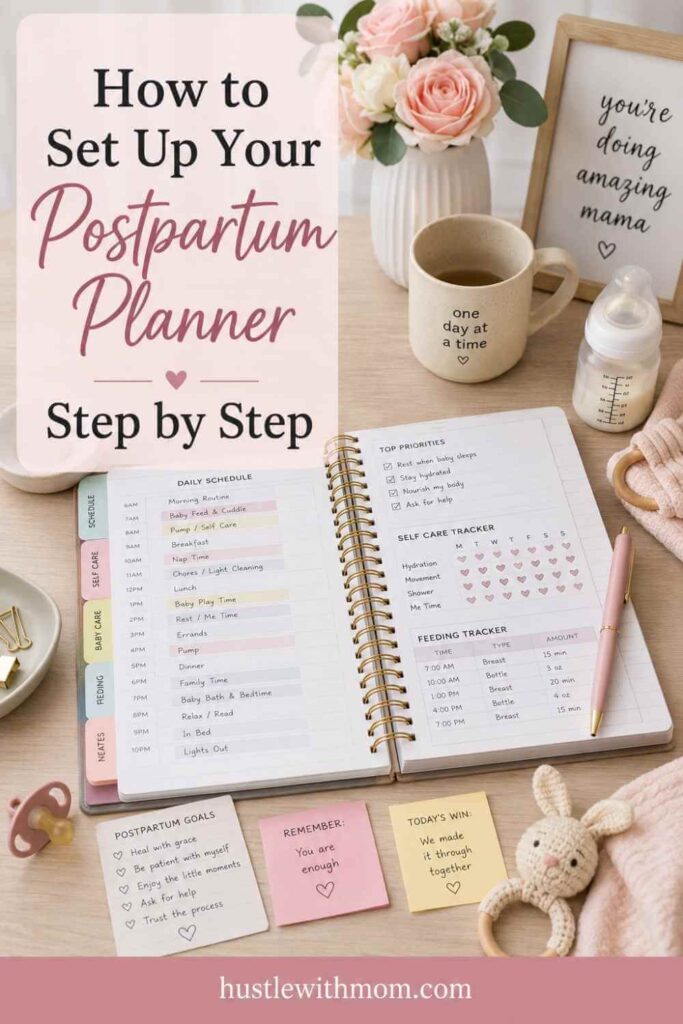
You don’t need a fancy system. Here’s the simplest way to start:
| Section | What Goes In It |
| Recovery Tracker | Weekly symptoms, appointments, warning signs |
| Sleep Plan | Shift schedule, visitor rules |
| Feeding Log | Times, sides, diapers, hydration |
| Meal Plan | Freezer meals, helpers list |
| Mental Health | Weekly mood check-ins, contact numbers |
| Support Map | Who does what and when |
| Self-Care | Daily 5-point checklist |
Print it out and put it somewhere you’ll actually see it not buried in a drawer.
FAQ:
When should I start my postpartum planner?
The earlier the better most moms find 35–37 weeks a good time. You still have energy to think, and you can walk your partner or support person through it before things get intense.
Does a postpartum planner replace a birth plan?
No they work together. Your birth plan covers labor and delivery. Your postpartum planner starts the moment baby arrives and carries you through the first 6–12 weeks of recovery.
What if I’m a single mom is a postpartum planner still useful?
Absolutely maybe even more so. It helps you identify exactly where you need outside help and who to call. Planning it out in advance means you’re not figuring it out alone at 2am.
Should I include baby tracking in my postpartum planner?
You can. Many moms keep a separate newborn log for feeds and diapers, then a personal planner for their own recovery. Both are useful just keep them separate so your needs don’t get buried under baby’s schedule.
What if I had a C-section? does anything change?
Yes your physical recovery section will be more detailed, and your movement and exercise timelines will be different. Add a specific C-section recovery checklist and make sure your support map includes who’s handling all lifting and housework for the first few weeks. Always follow your doctor’s guidance.
Is it normal to feel completely lost in the first two weeks?
Yes. Completely. The first two weeks are the hardest for most moms. If you have a planner set up, you’re already one step ahead of where most of us were.
Conclusion:
Nobody comes home from the hospital feeling ready. But having a postpartum planner for mom means you have a framework, something to return to when the days feel shapeless and the nights feel endless.
Start simple. One section at a time. And remember: you planning for yourself isn’t selfish. It’s the smartest thing you can do for your baby, too.
Did you set up a postpartum plan before or after the baby came? Share what you wish you’d included, drop it in the comments below.
1 thought on “The Postpartum Planner for Mom That Actually Gets You Through the Fourth Trimester”